
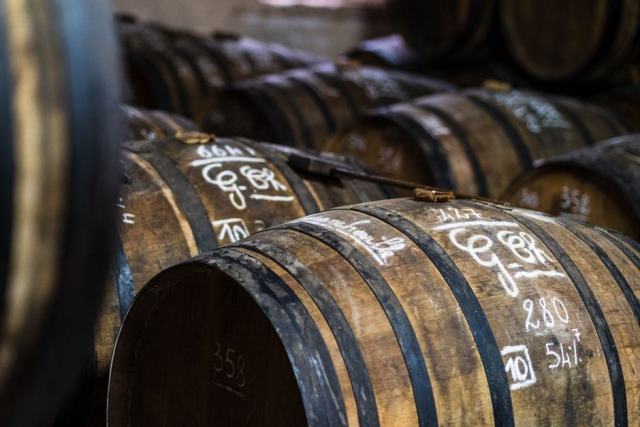
Bordeaux en primeur is the sale of a wine still ageing in barrel, bought in the spring after the harvest and delivered about two years later. The châteaux of the Médoc, Saint-Émilion and Pomerol all price their vintage this way. Whether that price is still a bargain is a test you can run yourself, by setting the release price against older bottled vintages of the same wine. A buyer ordering from a French merchant should also know that a confirmed order cannot be undone.
At a glance
- En primeur wines are tasted from barrel each spring, sold within weeks of that tasting, and delivered roughly eighteen to twenty four months later, once bottling is done.
- The blend is not final: a Left Bank grand vin is led by cabernet sauvignon, a Right Bank one by merlot, and the proportions can still move.
- The château sets the release price and sells to négociants, so the wine reaches you through at least two further margins.
- The test that matters is simple: compare the release price against older bottled vintages of the same wine on the open market, in bond against in bond.
- Bought at a distance from a French merchant, an en primeur order falls outside the usual cooling-off period, because the wine is delivered long after the sale and its value follows the market.
- Château Latour left the system after the 2011 vintage and now releases its wines only when it judges them ready.
What en primeur actually means
A Bordeaux wine sold en primeur has been picked, fermented and put into barrel, and nothing else. It has not been blended in its final proportions, it has not been bottled, and in most cases it will spend another year and a half in wood before it is. The buyer pays for a case that does not yet exist in the form they will eventually receive.
Every spring the trade and the wine press travel to Bordeaux for the week the locals call the dégustation, and taste the previous year's crop from barrel. The samples poured at those tastings are drawn from individual lots and assembled for the occasion. They give a serious taster a good idea of the raw material, of the growing conditions behind it and of the shape the millésime is taking, which is genuinely useful information. They are not the wine that will be shipped, and scores published from them carry that caveat whether or not it is printed alongside.
The practice is old. Bordeaux estates have raised money against unsold stock for centuries, and the modern Bordeaux campaign, with its fixed spring window and its press scores, took its present shape in the second half of the twentieth century. The crus classés of the Médoc all sell this way, alongside Pomerol, Saint-Émilion, Pessac-Léognan and the sweet wines of Sauternes and Barsac, each of them an Appellation d'Origine Contrôlée in its own right. The first growths and the châteaux around them are the wines the campaign is built to move.
What a taster is judging in an unfinished sample
The grape varieties are the starting point. On the Left Bank, in the Médoc and in Pessac-Léognan, the blend leads with cabernet sauvignon and fills out with merlot, cabernet franc and a little petit verdot. On the Right Bank, merlot dominates and cabernet franc plays the supporting part. The same growing season does not treat the two banks alike, which is why a vintage praised on one is not automatically praised on the other.
From the glass, a taster reads the fruit, the tannic structure, the acidity holding it together, the alcohol and the balance between them. A young cabernet sample tends to show dark berry fruit and a firm frame; a merlot sample from a warm year shows a rich, rounder profile with softer edges. What none of it shows is how those parts will sit together after another eighteen months in wood, which is the whole difficulty of the exercise. A note written in April is a statement about potential, and the vocabulary of the trade reflects that: wines are called structured, promising or closed rather than finished.
Old vines matter too. A parcel of vieilles vignes, generally taken to mean vines of forty years and more, yields less and tends to give more concentrated fruit, and its lots are usually the ones an estate reserves for its first wine.
How a barrel sample becomes a case in your name
The château, the courtier and the négociant
A Bordeaux estate does not sell to the public and, with rare exceptions, does not sell direct to importers either. It allocates its crop to négociants, the merchant houses of Bordeaux, and the match between an estate's allocation and a house's demand is usually made by a courtier, a broker who takes a commission from both sides. This arrangement is known as the Place de Bordeaux. It is not a formality: an estate that pulls its wine from a négociant can find that allocation hard to rebuild, which is part of why release prices hold up even in years when demand is thin.
Why the estate wants the money early
The classified châteaux pay for their harvest, their cellar staff and their new barrels in the autumn, and on the ordinary calendar they would see no cash from that vintage for another two years or more. En primeur closes that gap: it turns stock that cannot yet be shipped into revenue within months. On average an estate that sells this way is financing one vintage with money raised on the next, and a property that keeps its wine back has to carry two or three years of production on its own balance sheet before any of it is sold. That term risk is what the buyer is being paid to absorb, and it is the honest basis of the discount the system was built around.
The merchant you actually pay
The négociant sells on to importers and retailers around the world, and one of those is the company that takes your money. Each link sets its own margin, and none of them is the château. When you read that a wine was released at a given price, that figure is the ex château price. What reaches a private buyer sits above it, sometimes well above it, and the gap varies from one market to another.
What you own before the wine exists
What you hold after paying is a contractual claim on a case that will be delivered when it is bottled. In the United Kingdom that claim is normally recorded in bond, meaning the wine will sit in a customs bonded warehouse and that duty and sales tax have not yet been paid on it. The claim is only as good as the company that issued it, and that company has to still be trading in two years' time.
The Bordeaux campaign, month by month
The rhythm barely changes from one year to the next. The grapes of the new millésime come in during September and October. Through the following winter the wine settles in barrel and the blend is assembled. Around the start of April the trade arrives to taste, and within days the first scores and vintage reports appear.
Releases follow from late April through June, and they are staggered on purpose. An estate rarely offers everything at once: it puts out a first tranche, watches how quickly it clears, and prices later tranches accordingly. A wine that sells out in an afternoon will reappear dearer. A wine that does not move may see no second tranche at all, which is itself a piece of information about how the trade rates it.
Then nothing happens for a long time. The wine finishes its élevage in wood, and only then comes the mise en bouteille, the bottling itself. When a Bordeaux label carries the phrase mise en bouteille au château, it is saying that the bottling took place on the property rather than at a merchant's premises. After that the wine rests and is shipped. Two calendar years between payment and delivery is normal, and delays beyond that are not unusual. The Bordeaux wine council publishes the dates and the shape of each campaign on its own trade site.
The Grand Vin, the second wine, and what you are actually allocated
A campaign does not offer one wine per estate. Almost every classified property in the Bordelais now makes a Grand Vin, the first wine that carries the château name, and at least one second wine built from the lots that did not make the final blend: younger vines, parcels that ripened unevenly, barrels that were good without being right. Château Margaux has Pavillon Rouge, Lafite has Carruades, Latour has Les Forts de Latour, Mouton Rothschild has Le Petit Mouton, Château Haut-Brion has Le Clarence. All of them are sold en primeur beside the Grand Vin.
Second wines have grown in importance because selection has tightened. An estate that once put four barrels in five into its Grand Vin may now put three, which improves the first wine and produces a great deal more of the second. The same pattern runs down the classification: Pauillac châteaux such as Château Lynch-Bages and Margaux properties such as Château du Tertre, both classified in 1855, put out their second wines beside their first ones every spring. That matters to a buyer for a plain reason: a second wine is cheaper, but there is far more of it, and it will still be sitting on merchant lists in three years. The scarcity argument that justifies buying early does not apply to it in the way it applies to the Grand Vin of a small property. The complete list of Bordeaux second wines by estate shows which label belongs to which château.
Allocation is the other half of the picture. On the wines that genuinely sell out, a merchant does not serve whoever asks first; it serves the customers who have bought from it across several vintages, including the difficult ones. A buyer approaching a campaign for the first time should expect to be offered the appellation wines and the second wines rather than the crus classés that the offer letter leads with. The Margaux appellation, the estate at Château Margaux and the second wine of that estate are three different propositions at three different prices.
The whites and the sweet wines
The campaign is not only red. The dry whites of Pessac-Léognan, built on sauvignon blanc and sémillon, are offered alongside the reds, and so are the sweet wines of Sauternes and Barsac, where sémillon touched by botrytis gives the region its richest style. Château Suduiraut and its neighbours release en primeur like everyone else, though the sweet wines have had a harder market for two decades and are often still available long after the campaign has closed. For a buyer that is the clearest possible signal about which part of the offer carries any scarcity at all.
Ordering from a French merchant: a sale with no cooling-off period
French consumer law normally gives anyone who buys at a distance, online or by phone, 14 days to change their mind. Service-Public, the information portal of the French administration, lists an exception that fits en primeur exactly: alcoholic drinks whose delivery is deferred beyond 30 days and whose value depends on market rates, with wines reserved before the harvest given as the example. The exception is written into the Code de la consommation.
Selling and buying en primeur remains entirely lawful in France. What changes is the order of operations: a campaign order confirmed with a French merchant binds the buyer from that moment, so the price comparison set out further down this page has to be run before the order is placed, not after.
What the price covers, and what it leaves out
An en primeur price quoted in bond is not the sum you will have spent by the time you drink the wine. Duty and sales tax fall due when the case leaves the bonded warehouse, and both are calculated at the rates in force on that day, not on the day you paid. Storage in bond carries an annual charge per case. Delivery to a private address is billed separately.
None of this is hidden, and none of it is unreasonable. It matters because it makes comparisons treacherous. A price seen on a merchant list is often in bond and per case of twelve; a price seen in a shop is duty paid and per bottle. Comparing one against the other produces a discount that does not exist. The habit worth acquiring is to convert everything to the same basis before drawing any conclusion, exactly as with what any bottle price is actually made of.
Larger formats change the arithmetic again. A magnum is not simply two bottles at the same rate, and imperials and double magnums carry a premium that reflects how few are made.
When buying early is worth it
Three situations still justify the wait, and they have one thing in common: they are about access rather than price.
The first is genuine scarcity, and the difference in scale is worth naming. A Pomerol property such as Château La Fleur-Pétrus works a handful of hectares and makes a few thousand cases in a good year, fewer in a difficult one; Château Cheval Blanc, in Saint-Émilion, is not much less tightly held. Set that against a Haut-Médoc estate such as Château Beaumont, whose production runs to hundreds of thousands of bottles and which will sit on merchant lists for years. Once a scarce wine is bottled and dispersed, buying it means going to the secondary market and paying whatever that market asks. En primeur is the only moment at which a private buyer is offered it at all.
The second is format. Magnums, double magnums and imperials are made in tiny numbers and are largely allocated during the campaign. A buyer who wants a large format of a particular year has one realistic window, and it is this one.
The third is provenance. A case bought en primeur and left in bond has never been in a hot van or a domestic cupboard. For anyone thinking about the wine as a holding rather than as something to open, that unbroken chain is worth real money later, a point covered in more detail in our guide to wine as an investment.
When it stops being a bargain
The original bargain was straightforward. The estate needed money before the wine was saleable, the buyer supplied it, and the discount for waiting was the buyer's reward. That discount is the whole basis of the system, and it is not guaranteed by anything.
What makes that comparison possible at all is that Bordeaux now trades on an international fine wine market with published prices. Exchanges such as Liv-ex, launched in London in July 2000 as a trading platform for wine merchants, quote bottled vintages of the same wines continuously, so an offer made in April can be checked against what the market is asking for the 2015 or the 2016 of that château before anyone commits. A generation ago a private buyer had no such reference and had to take the offer letter on trust.
The release price is set by the château. It is not discovered by an auction and it is not negotiated with buyers. It reflects what the estate believes the vintage is worth, what it released the previous year at, and how the trade responded to the spring tastings. In several recent Bordeaux campaigns, wines have been released at prices at or above what older vintages of the same wine were already fetching on the open market, vintages that are bottled, physically available, scored from the bottle rather than the barrel, and free of any waiting.
When that happens, the buyer is paying two years early for no discount and taking on several risks in exchange for nothing. The test is one comparison, and anyone can run it before committing:
| What the offer implies | What has to be true for it to hold |
|---|---|
| You are getting in below the market | The release price is clearly under what two or three older vintages of the same wine cost today, in bond and per equivalent case |
| The score justifies the price | You accept that the score came from an unfinished barrel sample and may move once the wine is in bottle |
| The allocation is the point | The wine is genuinely hard to find later, which is true of very few of the larger Médoc estates |
| Your money is safe | The merchant will still be trading in two years, and your case is held in bond in your name rather than in the company's general stock |
That last line is not theoretical. Merchant failures have cost private buyers wine they had paid for in full, and the protection that matters is whether the stock sits in bond under your own name.
The estates that walked away
The most instructive verdict on the system came from inside Bordeaux itself. Château Latour announced in 2012 that it would stop selling en primeur; the 2011 was its last vintage offered that way. Since then it has held its wines in its own cellars and released them when it considers them ready to drink, at prices it sets on the day.
The estate's stated reasoning was that a wine tasted from barrel and sold years before it can be enjoyed serves the trade better than it serves the person who will eventually open it. Others have followed in part, offering only a share of production during the campaign and keeping the rest back.
The campaign has not collapsed and shows no sign of doing so. But a first growth deciding it could sell perfectly well without it is a fair indication that the early price is no longer the automatic advantage it once was. Anyone assembling a cellar should read the campaign the same way, one wine at a time, which is the approach set out in our guide to choosing and collecting.
Points buyers raise before their first campaign
Can an en primeur order be cancelled?
Generally not. The purchase is a firm commitment once the merchant confirms it, and the money has usually gone up the chain to the négociant. In France the legal cooling-off period for distance sales does not apply either, since the wine is delivered long after the sale at a value set by the market. Some merchants will let a buyer resell a holding through them, but that is a favour rather than a right.
What happens if the merchant goes out of business?
It depends entirely on how the stock was held. Wine held in bond, in a reserve account under your own name and with your own rotation number, is your property and is normally recoverable. Wine sitting in the company's general trading stock is not, and buyers in that position have lost cases they had paid for in full.
Does a barrel score predict the bottled wine?
It correlates, but it does not settle the matter. The sample is unfinished and the final blend may differ from what was poured in April. Scores published from the bottle several years later sometimes sit above the barrel score and sometimes below it.
Is en primeur cheaper than waiting?
Sometimes, and not reliably. It was consistently cheaper when the system was less crowded. Today the answer changes from one wine and one vintage to the next, which is why the comparison against older bottled vintages is worth running every time rather than assumed.
Which wines are still worth buying this way?
Those made in small quantities, those offered in large formats, and those from vintages the trade agrees are exceptional and which are priced with some restraint at the outset. For everything else, the wine will be there in two years, bottled, rated and often no dearer.