
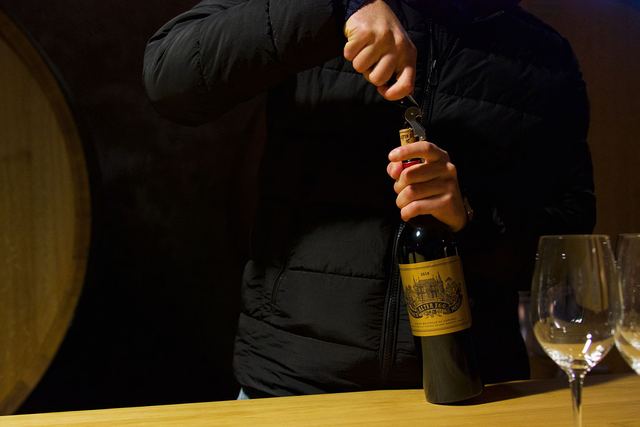
Château Latour is the Pauillac first growth best known for power, consistency and longevity. Its grand vin, drawn largely from the historic L'Enclos vineyard near the Gironde estuary, is built to age for decades and is now released only when the estate judges it ready.
Château Latour is widely regarded as the most consistent and long-lived of Bordeaux's five first growths. Its medieval tower, the inspiration for its name, overlooks L'Enclos, a 47-hectare parcel in southern Pauillac planted almost entirely with Cabernet Sauvignon. The exceptionally deep gravel soils over clay and limestone subsoils retain heat and drain perfectly, producing grapes of intense concentration even in difficult vintages. Latour was classified Premier Grand Cru in 1855 and has maintained that status through every génération since.
A Wine Built for Decades: Tasting Profile and Vintages
Latour's grand vin is dense and brooding in youth, requiring patience that few wines demand so insistently. Its aromatic signature includes blackcurrant, iron, graphite, leather and bay leaf, underpinned by monumental tannins that gradually integrate over 20 to 40 years. Extraordinary vintages, 1961, 1970, 1982, 1996, 2000, 2010 and 2015, are considered among the finest red wines ever produced anywhere. Even in lesser years, Latour's consistency is remarkable. The second wine, Les Forts de Latour, often rivals other estates' grand vins.
Latour's Historic Decision: Late Release and Organic Viticulture
In 2012, owner François Pinault withdrew Château Latour from the en primeur system, announcing that bottles would only be released when the estate considered them ready to drink. This bold decision, releasing the 2012 vintage in 2026, for instance, has reset expectations for fine wine maturity. Prices reflect this premium positioning, with récent releases typically starting at €700 - €1,000 per bottle, and fine older vintages commanding far higher sums at auction. The estate has also converted entirely to organic viticulture across its vineyards.
The Estuary Effect
Latour's vineyard lies close to the Gironde estuary, whose large body of water moderates temperatures. This proximity helps protect the vines from spring frost and contributes to even ripening, one reason the estate is renowned for producing fine wine in years when others struggle. The gravel ridges drain quickly after rain, forcing the roots deep into the subsoil, which gives the wine its depth and its slow evolution.
Three Wines from One Estate
Besides the grand vin and Les Forts de Latour, the estate produces a third wine labelled simply Pauillac, made from younger vines and lots not selected for the first two. This tiered approach is common among top Bordeaux châteaux and allows a strict selection for the grand vin. For buyers, the second and third wines offer an introduction to the Latour style at lower prices and with earlier drinking windows.
Latour and Its Neighbours
Latour shares Pauillac with two other first growths. Mouton Rothschild tends to be more exuberant and spicy, while Lafite is often described as more aromatic and refined. Latour is usually the most austere in youth and the most structured, with a firm tannic frame. Tasting them side by side shows how much the same appellation can vary according to soil, exposure and winemaking choices. A wider view of the classified estates is given in the guide to Bordeaux wine brands from the first growths to the right bank.
Serving and Cellaring Latour
- Keep bottles lying down in a dark, cool cellar with stable temperature and humidity.
- Decant mature vintages gently to separate the sediment, younger ones for longer to let them open.
- Serve at cellar temperature, slightly cooler than room temperature.
- Pair with roast lamb, rib of beef, game or mature hard cheeses.
Because the estate now releases wines later, bottles bought on release have already been cellared under ideal conditions, which reduces provenance concerns for recent vintages. For older bottles bought on the secondary market, documented storage remains essential, as for any of the world's most expensive and rare wines.