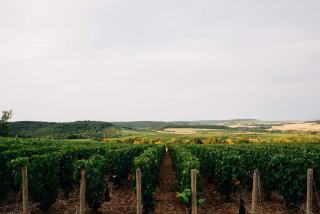
Château Lafite Rothschild, like Château Mouton Rothschild, consistently appears at the very top of Bordeaux rankings and auction records. The estate lies at the northern end of the Pauillac appellation, on the border with Saint-Estèphe, and was classified Premier Grand Cru in 1855, a position it has never relinquished. The Rothschild family acquired Lafite in 1868, and the same family has run it ever since. According to the estate, the vineyard covers 112 hectares, planted predominantly with Cabernet Sauvignon, supported by Merlot, Cabernet Franc and Petit Verdot.
Where the Lafite Vineyard Grows: Gravel, Sand and Limestone
The Lafite vineyard owes its style to a classic Médoc soil. The estate describes deep, fine gravel mixed with wind-blown sand, laid over a subsoil of tertiary limestone. Gravel drains quickly and stores the warmth of the day, which suits a late-ripening grape such as Cabernet Sauvignon; the limestone underneath keeps some moisture in reserve during dry summers. This combination explains why the grand vin is built on Cabernet Sauvignon in most years, with Merlot as the second partner and only a touch of Petit Verdot.
Vine age is a selection tool at Lafite. The estate reserves vines older than 10 years for the grand vin, while younger plots go into the second wine. Some very old parcels still grow on their own roots, a rarity in Bordeaux since phylloxera forced most growers to graft onto American rootstock.
Tasting Profile: Cedar, Graphite and Decades of Development
Lafite's hallmark is refinement rather than raw power. Expect aromas of blackcurrant, cedar pencil, graphite and a distinctive mineral thread that some describe as almost geological. In youth the wine is reserved, often appearing lighter than its peers from Pauillac. Given 15 to 25 years, it opens into something extraordinary: silky tannins, complex secondary notes of tobacco, dried flowers and forest floor. The legendary vintages, 1959, 1961, 1982, 1996, 2003 and 2010, remain benchmarks for the entire Bordeaux appellation system.
Serving a mature bottle of Lafite
An old Lafite rewards a careful approach. Stand the bottle upright for a day or two so the sediment settles, open it gently (an old cork often crumbles, and a two-pronged opener helps), then decant slowly in front of a light so the deposit stays behind. A young vintage benefits from several hours in a decanter; a fully mature one is better poured soon after opening, because its delicate aromas fade with too much air. Cellar temperature, slightly below room temperature, keeps the tannins silky. Classic matches are roast lamb, game birds or a simple rib of beef, which leave room for the wine's aromatic detail.
Carruades de Lafite and the Rest of the Family
The second wine, Carruades de Lafite, shares similar grape varieties and winemaking philosophy and costs a fraction of the grand vin, an accessible entry point to this storied estate. It takes its name from the Carruades plateau, a group of plots historically attached to Lafite, and it is made mainly from the younger vines. Carruades tends to be more approachable early, with the same cedar and blackcurrant signature in a lighter frame. Beyond Pauillac, the Rothschild group behind Lafite also owns other properties, but none carries the Lafite name on the label except the grand vin and Carruades.
How Lafite Prices Are Set and How to Buy
The price of Château Lafite Rothschild depends on three things: the reputation of the vintage, the volume released by the estate through the Bordeaux négociant system, and demand from collectors, which has been especially strong in Asian markets. Great years and older bottles with documented storage command a large premium over standard vintages, and auction results vary widely with provenance. Buying through négociants or directly en primeur during spring tastings offers the best value, since the wine is purchased before bottling and delivered about two years later.
Checking a bottle before buying
Lafite is one of the most counterfeited wines in the world, so provenance matters as much as the vintage. Ask for an invoice trail back to a recognised merchant, check the capsule and label against photos of authentic bottles from the same year, and look at the fill level: a low shoulder on an old bottle signals air exposure. Original wooden cases, kept closed, reassure buyers at resale. In France, wine bought for home consumption stays subject to the usual retail rules, and labels of recent vintages carry the allergen mention for sulphites.
Lafite Rothschild Questions: Vineyard, Second Wine and Ageing
Who owns Château Lafite Rothschild?
Château Lafite Rothschild belongs to the Rothschild family, which bought the estate in 1868; it still manages it through Domaines Barons de Rothschild (Lafite).
How long should Lafite age before opening?
Château Lafite Rothschild usually needs 15 to 25 years to show its full complexity; great vintages keep evolving well beyond that in a cool, dark and steady cellar.
What is the difference between Lafite and Carruades?
Château Lafite Rothschild is the grand vin, made from older vines, while Carruades de Lafite comes mostly from younger plots and is designed to be enjoyed sooner, at a lower price.
In this section: 3 articles
- Romanée-Conti: Inside Burgundy's Most Precious Grand CruMarch 21, 2026
- Burgundy Wine Brands: Top Domaines, Négociants and Value PicksJanuary 12, 2026
- Champagne Brands: Grandes Marques, Growers and CuvéesJanuary 9, 2026